Post by : Avinab Raana
Photo : X / @vargasmoni
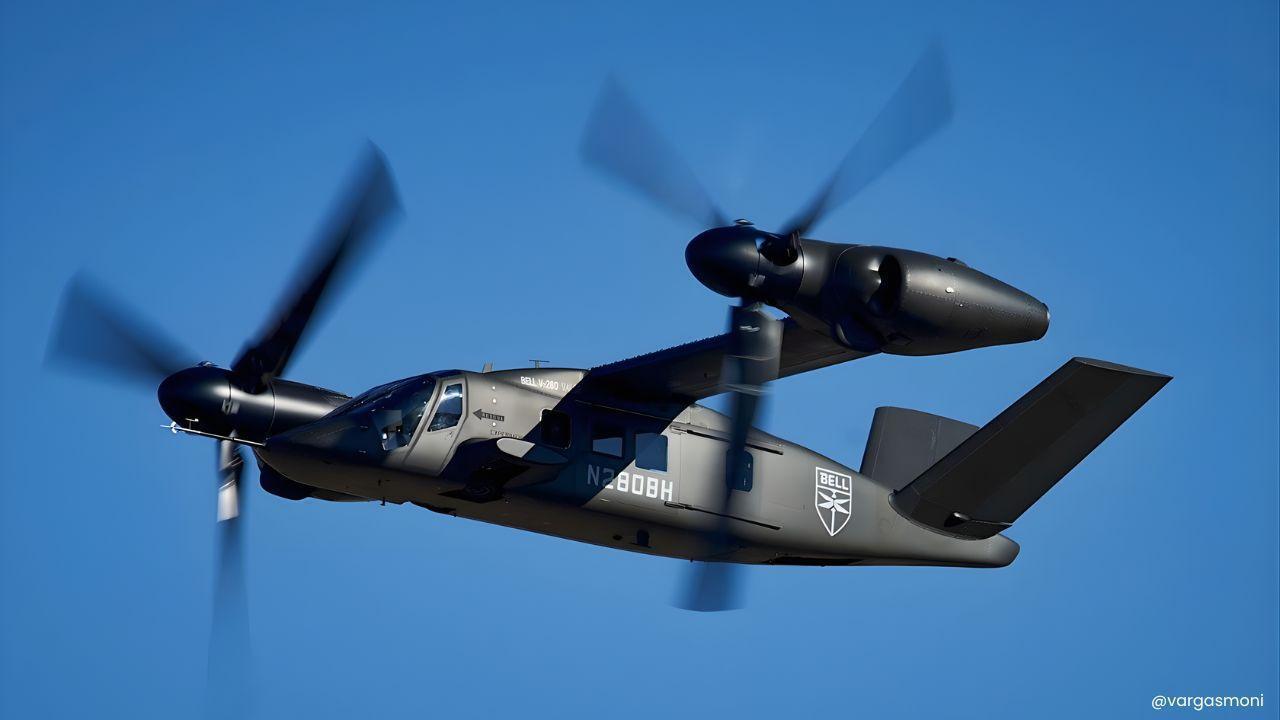
The U.S. Army’s next-generation tiltrotor aircraft, the Bell MV-75, is racing against time in what officials describe as a “no-slack” schedule—an aggressive development push that reflects the urgency of modern warfare demands. But with speed comes risk, and this program is now walking a fine line between rapid innovation and operational uncertainty.
Originally envisioned as a long-term modernization effort, the MV-75 program has been dramatically accelerated by the U.S. Army. The first aircraft is now expected to be delivered as early as late 2026 or early 2027, significantly ahead of earlier timelines that stretched into the next decade.
Army leadership has made it clear that this acceleration is not optional. It is driven by the urgent need to replace aging rotorcraft fleets with faster, longer-range, and more capable systems. The first operational unit equipped with around 24 tiltrotor aircraft is targeted by 2030, compressing what would traditionally be a multi-phase rollout into a tightly packed execution plan.
Officials have described the MV-75 schedule as “success-oriented,” meaning that virtually all flexibility has been stripped out of the development timeline.This approach assumes that every stage from design validation to production and testing proceeds without major setbacks. While this allows for faster deployment, it also introduces significant risk. As Army leaders have acknowledged, there is little room for delays or technical issues, making the program highly sensitive to even minor disruptions.The reality is stark: the MV-75 must succeed on its first attempt, or the consequences could ripple across timelines, budgets, and operational readiness.
The MV-75 represents a major leap in aviation technology, combining vertical takeoff and landing with airplane-like speed and range. Designed to fly “twice as far and twice as fast” as traditional helicopters, it is expected to transform how military operations are conducted across large and contested environments.
Unlike earlier tiltrotor platforms, the MV-75 incorporates simplified engineering features, improved materials, and digital design methodologies aimed at reducing maintenance complexity and enhancing reliability. Lessons learned from previous programs have been directly integrated into the aircraft’s design to avoid historical pitfalls.
One of the key strategies behind the MV-75 program is learning from the challenges faced by earlier tiltrotor aircraft like the V-22 Osprey. The Army has analyzed decades of operational data to eliminate common issues related to maintenance, structural stress, and system complexity.
Design improvements include simplified wing structures, more efficient hydraulic systems, and advanced materials aimed at improving durability. The use of well-understood engine platforms and established supplier networks further reduces technical risk, allowing the program to move faster without reinventing every component.
In a departure from traditional defense procurement models, production of MV-75 components has already begun even as the design continues to evolve. This overlapping of development and manufacturing phases is a calculated risk intended to save time and accelerate delivery.
The Army is also leveraging digital engineering tools, including virtual prototypes, to simulate performance and identify issues early. This approach allows for faster decision-making and reduces reliance on lengthy physical testing cycles, but it also places significant trust in modeling accuracy.
The MV-75 is not just another aircraft, it is a cornerstone of the Army’s future operational strategy. With its extended range and speed, it enables rapid deployment across vast regions, particularly in theaters like the Indo-Pacific where distance is a critical factor.
Training programs and simulation systems are already being introduced to prepare pilots and crews for this new capability, even before the first aircraft is fully operational. This parallel preparation highlights the urgency with which the Army is pushing the program forward.
The MV-75 program represents one of the most ambitious efforts in modern military aviation, a project that could redefine battlefield mobility if successful. But the lack of schedule flexibility means that every phase must execute flawlessly.
As global military competition intensifies and technology cycles accelerate, programs like the MV-75 are setting a new benchmark for speed and innovation. The question now is whether this “no-slack” approach will deliver a breakthrough or expose the limits of accelerated defense development.
#trending #latest#MV75 #BellTextron #MilitaryAviation #DefenseTechnology #Tiltrotor







Advances in Aerospace Technology and Commercial Aviation Recovery
Insights into breakthrough aerospace technologies and commercial aviation’s recovery amid 2025 chall

Defense Modernization and Strategic Spending Trends
Explore key trends in global defense modernization and strategic military spending shaping 2025 secu

Tens of Thousands Protest in Serbia on Anniversary of Deadly Roof Collapse
Tens of thousands in Novi Sad mark a year since a deadly station roof collapse that killed 16, prote

Canada PM Carney Apologizes to Trump Over Controversial Reagan Anti-Tariff Ad
Canadian PM Mark Carney apologized to President Trump over an Ontario anti-tariff ad quoting Reagan,

The ad that stirred a hornets nest, and made Canadian PM Carney say sorry to Trump
Canadian PM Mark Carney apologizes to US President Trump after a tariff-related ad causes diplomatic

Bengaluru-Mumbai Superfast Train Approved After 30-Year Wait
Railways approves new superfast train connecting Bengaluru and Mumbai, ending a 30-year demand, easi



